Powered access
Powered access equipment
If you are going up in the world, the machine has to get you there safely. A full range of MEWPs — mobile elevating work platforms — for sale and for hire, from the team that services, examines and trains on them afterwards.
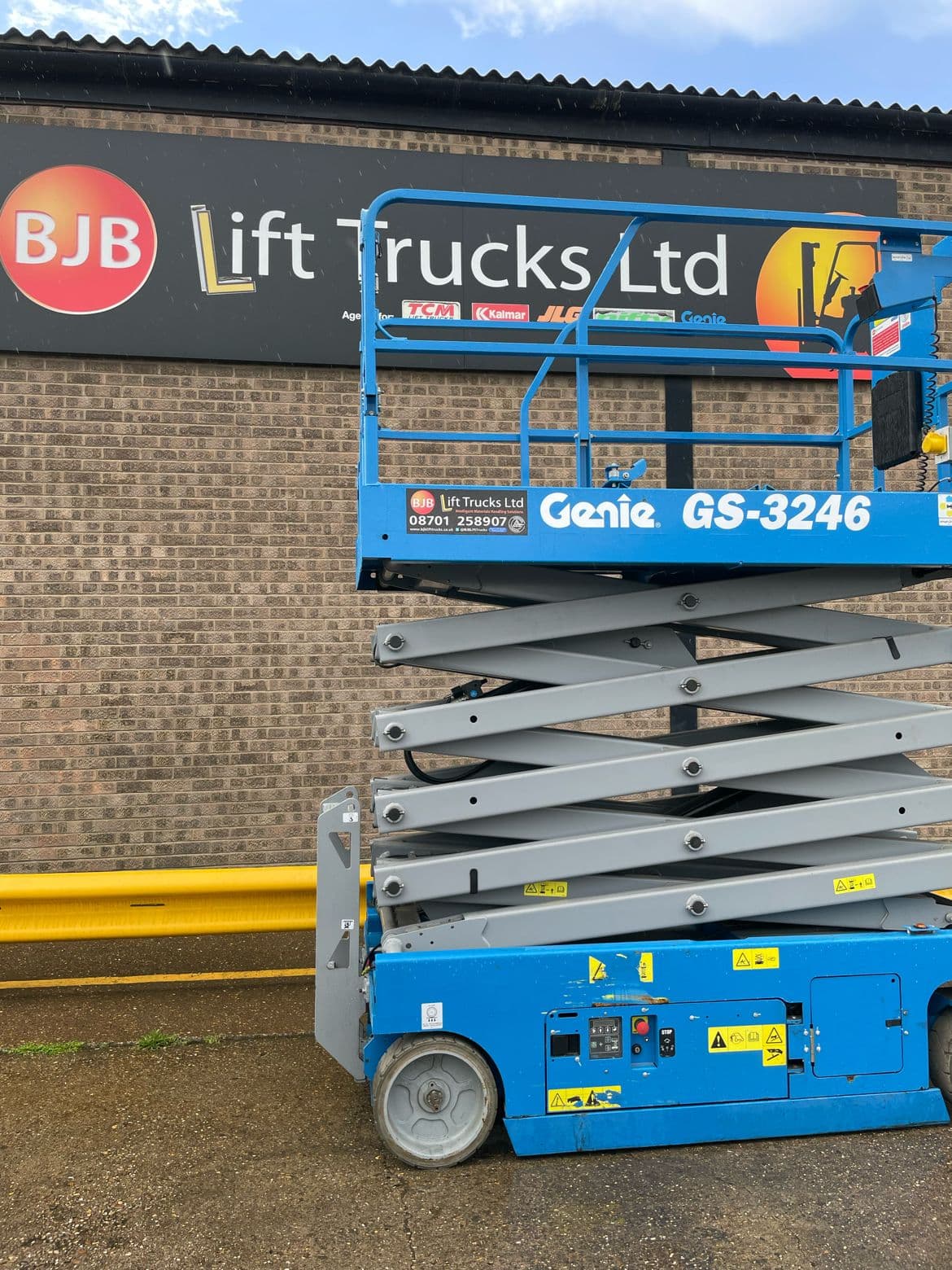
Scissor lift or cherry picker, bought outright or hired for a job, we will advise on the model that lets you carry out the work successfully and — more to the point — safely.
Buying the platform is the start of it. We support you and your team afterwards with servicing, the six-monthly LOLER thorough examination, repairs, parts and accredited operator training, which is what makes us a single place to deal with rather than four.
To recommend the right platform we will ask
- Working height required, and how far out from the base
- Indoor, outdoor or both
- Ground conditions, and what the floor will bear
- Access to the work area — doorways, lifts, ramps
- How many people and how much material go up
- Whether it is one job or ongoing
What we cover
- Scissor lifts
- Vertical platforms for maintenance, installation and fit-out where the work is straight above you. Electric for indoors, rough-terrain for outside.
- Cherry pickers and boom lifts
- Articulating and telescopic booms for work you cannot get directly underneath, or that is a long way out as well as up.
- Sale or hire
- Buy outright, or hire short or long term from our own fleet — including cover while your own machine is off the road.
- Servicing and LOLER
- A MEWP lifts people, so under LOLER it needs a thorough examination at least every six months. We do the servicing and the examination, and issue the report.
- Parts
- Spare parts for access equipment as well as for the truck fleet, on all makes.
- IPAF training
- 3a for scissor lifts, 3b for booms, 1a and 1b for static platforms — at our Grimsby centre or on your site on your own machines.
Which platform
Four kinds of machine, four kinds of job
Choosing wrongly usually shows up as a machine that cannot get to the work, or one that can but has to be parked somewhere it should not be. The question is where the work is relative to where the machine can stand.
IPAF 3a
Scissor lifts
A large, level platform that rises straight up on a folding frame. The most stable and the roomiest of the four, so it carries more people and more material than a boom. Electric models for indoor floors; diesel or bi-energy rough-terrain models with bigger tyres and outriggers for outside.
Suits: Ceilings, lighting, ductwork, cladding, racking — anything directly overhead where the machine can park underneath the work.
IPAF 3b
Articulating boom lifts
A cherry picker with a jointed boom. The knuckle lets the platform go up, over and back down, so it reaches over obstructions and into places a straight line cannot. Smaller platform than a scissor, usually one or two people and hand tools.
Suits: Working around plant, over pipework, into a roof void from the side, or wherever the machine cannot sit directly beneath the job.
IPAF 3b
Telescopic boom lifts
A straight boom that extends. Maximum outreach and height for the footprint, at the cost of the articulating boom's ability to bend round things. The choice when the work is a long way out horizontally as well as up.
Suits: Steelwork, large facades, tall structures, and outdoor sites where reach matters more than manoeuvrability.
IPAF 1a / 3a
Vertical mast and push-around lifts
A compact single-person platform on a mast. Light enough for finished floors and mezzanines, narrow enough for a standard doorway, and quick to position. Static versions are wheeled into place and then raised; self-propelled versions drive at height.
Suits: Maintenance and stock work in retail, offices, plant rooms and warehouses at modest heights.
Electric, diesel or both
Electric machines are quiet, fume-free and light on their tyres, which is what a finished floor, a food plant or a working warehouse needs. Diesel rough-terrain machines carry bigger tyres, four-wheel drive and outriggers for uneven ground, and are what a construction site or a yard needs. Bi-energy machines run on either, for a job that starts outside and finishes in. Tell us where the machine will live and the power question usually answers itself.
Our guide on scissor lift or cherry picker works through the choice in more detail, and what a cherry picker actually is covers the machine itself.
What we supply
Genie access platforms
Our access range is built around Genie scissor lifts and platforms. The GS-1930 is the machine most of our customers start with: a self-propelled electric scissor lift working to 7.79 metres, with a 227 kg platform, a compact frame and a zero inside turning radius, built for confined indoor spaces where precision matters as much as height.
Beyond that, tell us the height, the reach and the ground and we will specify the platform — scissor, articulating or telescopic, electric or rough-terrain — and quote it to buy or to hire. Specifications and lead times are confirmed on enquiry, because they change with the build and the options.
Hire or buy
Access equipment is hired more often than it is bought, and for good reason: the need is usually a project rather than a permanent fixture, and a hired machine arrives with its thorough examination in date and goes back when the ceiling is finished. Buying makes sense when a platform will be in use most weeks — a maintenance team on a large site, say — and we sell as well as hire, so we have no reason to steer you either way.
Hire terms are the same as for the truck fleet: delivery and collection on our own transport, servicing, thorough examination and breakdown cover inside the hire, and operators trained on the machine at your site if they are not already carded.
Working at height, done properly
The four things that go wrong
The Health and Safety Executive’s guidance on MEWPs comes down to four hazards. A platform that is specified, positioned and operated with these in mind is a safe machine; one that is not is the same machine with a different outcome.
- Falling from the platform
- Guardrails are the primary protection on every MEWP. In a boom-type machine, a harness with a short restraint lanyard clipped to the designated anchor point stops the operator being thrown out if the boom is struck or bounces. In a scissor lift a harness is not usually required, and the course covers which machine needs what.
- Entrapment
- Being caught between the platform and a beam, a duct or a doorway as the machine rises or drives. It is the hazard the industry has worked hardest on in recent years: look up before you move, use secondary guarding where the machine has it, and plan the route at height before you take it.
- Overturning
- Soft or sloping ground, an unnoticed drain cover, an outrigger not deployed, or a load over the platform's rating. Ground conditions are checked before the machine is positioned, not after, and wind ratings are respected outdoors — a boom at full height is a sail.
- Collision
- With overhead power lines, with structure, or with a vehicle hitting the machine from below. Overhead services are located before work starts and an exclusion zone is kept around the base while the platform is raised.
Before every shift
A pre-use check by the operator: tyres or tracks, outriggers and their pads, guardrails and gate, emergency lowering, ground controls, fluid levels, and the platform load rating against what is going up. It takes minutes, it is the operator’s responsibility whoever owns the machine, and it is where most faults are caught before they matter.
If someone is stranded
Every MEWP has ground-level emergency controls and a manual descent. A rescue plan is required before work starts, and someone on the ground has to know how to use those controls. Leaving it to the emergency services is not a plan: a casualty suspended in a harness needs bringing down in minutes, not waiting for an appliance.
Keeping it legal
What the law asks of a MEWP and its operator
The machine
A MEWP is lifting equipment that lifts people, so under the Lifting Operations and Lifting Equipment Regulations it needs a thorough examination by a competent person at least every six months — twice the frequency of a forklift, which lifts loads and is examined every twelve. It also needs one before first use, after being assembled or installed in a new place, and after anything exceptional: damage, a long lay-up or a significant repair. The examiner issues a written report stating the next due date and any defect, and a serious defect takes the machine out of use until it is fixed. We carry out the examination and the servicing under the Provision and Use of Work Equipment Regulations, and can do both on one visit.
Read more on our LOLER thorough examination page.
The operator
The Work at Height Regulations require that anyone using a MEWP is competent, and the recognised way of showing it is an IPAF PAL Card — the Powered Access Licence — which records the categories the holder is trained on and is valid for five years. The categories follow the machine: 3a for mobile vertical platforms such as scissor lifts, 3b for mobile booms such as cherry pickers, and 1a and 1b for their static equivalents. Most operators take 3a and 3b together in a day.
A card is not the whole of it. The operator also needs familiarisation with the specific machine they are about to use, and the employer’s authorisation. We run IPAF courses at our Grimsby centre or on your site, and training on a hired machine at your premises is often the most useful version.
Before you hire or buy
Powered access questions
Rest on a question, or tap it, for the answer
You need training and your employer's authorisation. An IPAF PAL Card is the accepted way of showing it, and most sites and hire companies will not release a machine without one. We run IPAF 1a, 1b, 3a and 3b at our Grimsby centre or on your site.
A scissor lift goes straight up on a large, stable platform and suits work directly overhead. A cherry picker is a boom lift: it swings a smaller platform out on an arm and reaches over or around an obstruction. Different machines, different IPAF categories — 3a and 3b.
Yes. Scissor lifts and boom lifts hire short term for a single job or long term alongside a truck fleet. If the machine is for one project, hire almost always makes more sense than buying, and it arrives with its thorough examination in date.
At least every six months, because it lifts people — against every twelve months for a forklift that only lifts loads. Also before first use, after being installed somewhere new, and after damage or a long period out of service. We carry them out and issue the written report.
Usually not: the guardrails are the protection and the platform is designed to be stood in. In a boom-type machine a harness with a short restraint lanyard, clipped to the designated anchor point, is normally required so the operator cannot be thrown out if the boom is struck or jolted. Site rules can be stricter than the guidance, so check.
Rough-terrain and bi-energy machines are built for it, with bigger tyres, four-wheel drive and outriggers. Slab electric machines are for level, firm floors and should stay on them. Outdoors, ground bearing and wind become part of the plan: a raised boom is a sail, and every machine has a maximum wind speed on its plate.
Every MEWP has ground-level emergency controls and a manual descent system, and rescue is part of the IPAF course rather than an afterthought. A rescue plan is required before work starts, and someone on the ground has to be able to bring the platform down.
Yes. Servicing, repairs, parts and thorough examination cover all makes, the same as the truck fleet, so mixed access and materials handling equipment can sit with one supplier.
Tell us how high you need to get
Give us the working height, the outreach, the ground and the job, and we will tell you which machine does it and whether buying or hiring is the better call.